


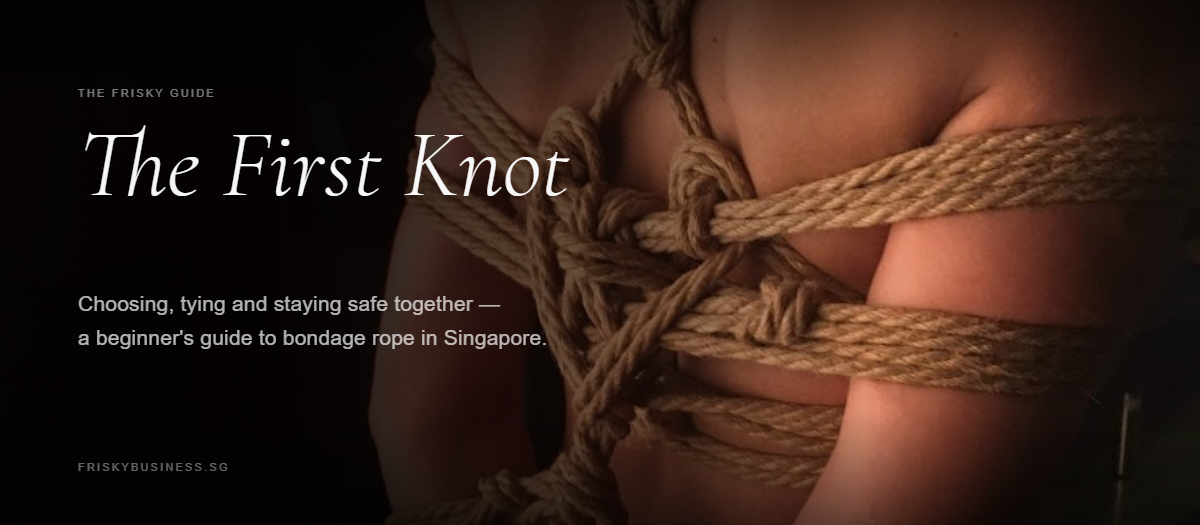
Bondage Rope in Singapore: How to Choose It and Tie Your First Ties
Rope is the cheapest way into bondage and the easiest way to get it wrong. A twelve-dollar coil of jute can carry more tension — literally and otherwise — than a drawer full of buckled cuffs, but it asks something in return: that you learn where the nerves run, how to check circulation, and when to stop. This guide covers what rope to buy in Singapore, how much of it you actually need, which ties are worth learning first, and the habits that separate confident rope work from an evening that ends badly. If you are still deciding whether rope is your entry point at all, start with our beginner's guide to BDSM in Singapore.
What kind of rope should you buy first?
For a first purchase, cotton or a soft 6mm jute is the sensible choice. Cotton is forgiving and cheap; jute holds a knot beautifully and is what most rope traditions are built around. Synthetic rope is the easiest to clean and the best behaved in Singapore's humidity.
Rope is not one material with one personality. What you buy changes how it feels, how it holds, and how much maintenance it asks of you.
- Jute and hemp — the traditional choice. Light, grippy, holds a knot without slipping, and has a dry texture many people find part of the appeal. Natural fibre needs a little care: keep it dry, air it after use, and expect it to soften with age.
- Cotton — soft, inexpensive, and kind to skin. The trade-off is stretch: cotton gives under tension, so a tie you set at the right snugness can loosen, and knots can cinch tight and jam. Excellent for learning, less precise for detailed work.
- Nylon and other synthetics — smooth, strong, machine-washable, and unbothered by damp weather. Because they are slippery, knots need to be dressed properly or they will creep. If you live in a humid flat and want low-maintenance rope, this is the pragmatic pick.
- Novelty rope — glow-in-the-dark, coloured, or pre-cut sets. Fun, and often a gentler introduction than a bare hank of hemp.
Diameter matters as much as fibre. Around 5–6mm is the standard working thickness: thin enough to tie neatly, thick enough to spread pressure across skin rather than biting into it. Anything much thinner behaves like cord and concentrates force in one line — which is exactly what you do not want.
How much rope do you actually need?
Eight metres is the standard working length for a single piece of rope. Two eight-metre lengths plus one shorter four-to-five-metre length will cover almost everything a beginner wants to do.
New buyers routinely make one of two mistakes: buying a single short length that runs out halfway through a tie, or buying fifty metres of one continuous rope that becomes an unmanageable tangle. Neither is fun.
Think in pieces, not in total metres. One eight-metre length is enough for a wrist tie, an ankle tie, or a simple chest wrap on most bodies. A second length lets you build on the first. A shorter piece is useful for cuffs, for tidying off a loose end, or for a quick tie when you do not want to manage a long rope. Buy two or three pieces before you buy more length.
Coil each piece separately and store it dry — Singapore's humidity is unkind to natural fibre left bundled in a sealed box. If discretion is the concern, our guide to storing toys safely and discreetly applies just as well to rope.
Which ties should a beginner learn, and in what order?
Learn the single-column tie first, then the two-column tie, then a simple chest harness. Everything else in rope work is a variation or a combination of those three.
Rope is a skill, not a purchase, and the honest advice is to learn it in sequence rather than attempting something ambitious from a photograph.
- The single-column tie binds one limb — a wrist, an ankle, a thigh. It is the foundation: if you can tie one column securely, without it tightening as your partner moves, you have the core competence rope depends on.
- The two-column tie binds two things together — wrist to wrist, ankle to ankle, wrist to thigh. Same principle, twice the usefulness, and the basis of most restraint positions.
- A simple chest harness is where rope starts to look like rope. It is a set of wraps across the chest anchored to a column tie at the back. Take it slowly and check breathing throughout.
What to skip, for now: anything suspended, anything that crosses the neck, and anything that puts weight on a single wrap. Suspension is a genuinely technical discipline with real injury risk and is learned in person, not from a diagram. If rope as an art form is what draws you, our introduction to shibari covers the culture and philosophy behind it.
How do you tie safely?
Keep safety shears within arm's reach, avoid the outside of the wrist and the inside of the elbow and knee, check circulation every few minutes, and never leave a tied person alone — not for a moment.
Rope safety is not complicated, but it is non-negotiable. The rules that matter:
- Nerve paths, not just circulation. The vulnerable spots are the outside of the wrist, the inner elbow, behind the knee, and the inside of the upper arm. Numbness, tingling or a "pins and needles" feeling means untie now, not in a minute.
- Two fingers of room. You should be able to slide two fingers under any wrap. If you cannot, it is too tight, however good it looks.
- Colour and temperature checks. Cool skin, dusky or blue fingertips, or a hand that has gone pale means the tie comes off immediately.
- A cutting tool you can reach one-handed. Blunt-nosed safety shears, kept on the bed, not in a drawer across the room. Knots you tied confidently can jam under load.
- A signal that works without speech. If a gag is involved, agree a non-verbal cue — a dropped object, a set number of taps.
- Time limits. Twenty minutes in one position is plenty when you are starting. Long sessions are an advanced skill, not a beginner ambition.
Everything that happens after the rope comes off matters too. Our guide to BDSM aftercare and safety covers the wind-down properly, and D/s roles explained is worth reading if you are negotiating this dynamic for the first time.
Rope, cuffs or tape — which suits you?
Rope offers the most control and the steepest learning curve. Cuffs are instant, adjustable and hard to get wrong. Bondage tape is the gentlest introduction of all: it sticks to itself, never to skin, and comes off in seconds.
There is no hierarchy here, only fit. Rope rewards patience and gives you something to practise; it is also the most time-consuming option and the one most likely to be abandoned in a drawer if the first attempt frustrates you.
Restraints and cuffs take ten seconds to put on, release instantly, and are the right answer if the appeal is the restraint rather than the ritual. Our step-by-step guide to using bondage restraints covers those in detail. Bondage tape sits neatly in between — visually striking, effectively risk-free, and forgiving of inexperience.
Many people end up owning all three. If you would rather buy one considered set than assemble it piece by piece, our BDSM starter kits guide compares the boxed options, and Bondage Kits lists what is in stock now.
Our top picks
All four are in stock in our Yishun warehouse and ship the same day across Singapore in plain, unbranded packaging.
- OBEY — BDSM Bondage Hemp Rope (from SGD 20) — the traditional choice. Grippy, holds a knot without creeping, and the natural fibre most rope technique was developed around. Our recommendation if you intend to actually learn rope rather than own it.
- OBEY — BDSM Bondage Rope (from SGD 12) — the low-commitment entry point. Soft, cheap enough to buy two lengths without thinking about it, and forgiving while your hands learn what they are doing.
- SHOTS Ouch! Rope, Glow in the Dark — 5m (SGD 31) — a five-metre synthetic length that glows. Easy to clean, unbothered by humidity, and genuinely useful for low-light play where you still want to see where the rope sits.
- BDSM — Tape Me Wild Bondage Tape (SGD 15) — the gentlest way to try restraint. Clings to itself rather than to skin, needs no technique, and unwraps in seconds. Worth having alongside rope even once you are competent.
Frequently asked questions
What is the best bondage rope for beginners?
Cotton or a soft 6mm jute. Cotton is the most forgiving and the cheapest to experiment with; jute holds knots more reliably and is what most rope technique assumes. Avoid thin cord and anything under about 5mm, which concentrates pressure instead of spreading it.
How long should bondage rope be?
Eight metres is the standard working length for one piece. A sensible starter set is two eight-metre lengths plus one shorter four-to-five-metre piece — enough for wrists, ankles and a simple chest tie without wrestling an unmanageable coil.
Is rope bondage safe?
It is safe within clear limits: nothing across the neck, nothing suspended, safety shears within reach, circulation and sensation checked every few minutes, and the tied person never left alone. Numbness, tingling, cool skin or discoloured fingertips means untie immediately. Sessions of around twenty minutes are plenty when you are learning.
Can you wash bondage rope?
Synthetic rope can be washed and air-dried without fuss. Natural fibre — jute, hemp, cotton — should be spot-cleaned and aired rather than soaked, since wetting it weakens the fibre and stiffens it. In Singapore's humidity, air natural rope properly after every use and store it loosely coiled somewhere dry.
Do I really need safety shears?
Yes. Blunt-nosed safety shears are the one accessory that is not optional, because a knot that has tightened under load can be impossible to release by hand. Keep them within arm's reach of wherever you tie — not in a drawer on the other side of the room.
Where can I buy bondage rope in Singapore?
Frisky Business stocks rope, tape and restraints for same-day delivery across Singapore in plain, unbranded packaging, and our Yishun warehouse is open for walk-ins if you would rather feel the fibre before you buy. We have served more than 30,000 Singapore customers since 2015, with over 13,200 verified five-star reviews.
Rope is one of the few things in this category where the cheapest option is also a genuinely good one — the cost is your attention, not your money. Buy two lengths, learn one tie properly, keep the shears on the bed, and build from there. Browse our full range of ropes and tapes, or explore the wider bondage gear and BDSM ranges — all discreetly delivered across Singapore.
Leave a comment
This site is protected by hCaptcha and the hCaptcha Privacy Policy and Terms of Service apply.