


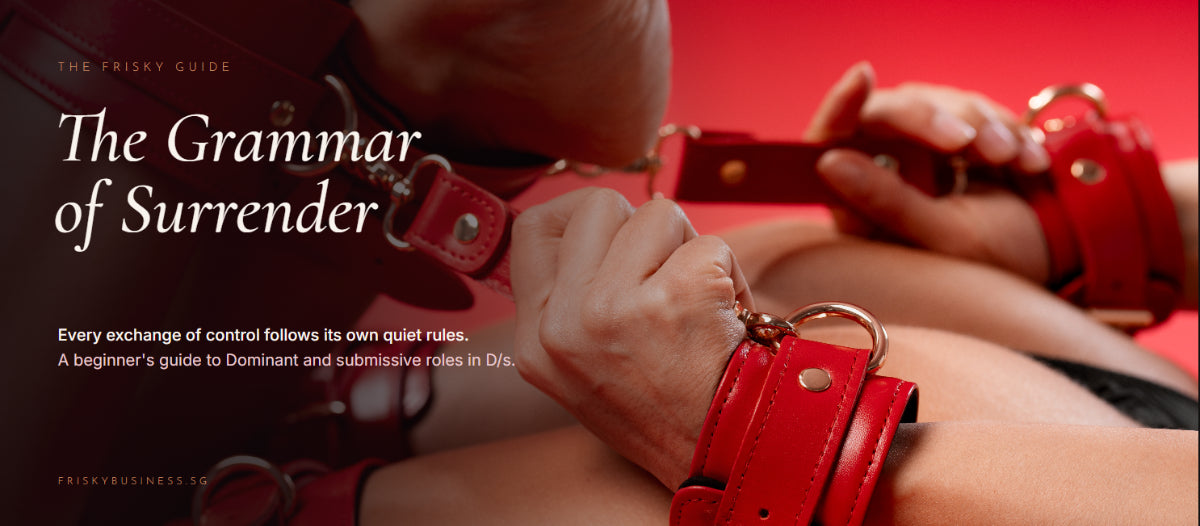
Dominant & Submissive Roles Explained: A Beginner's Guide to D/s Dynamics
ADVICE & HOW-TO
Dominant & Submissive Roles Explained: A Beginner's Guide to D/s Dynamics
Dom. Sub. Switch. The vocabulary of dominance and submission gets thrown around freely, yet it's rarely explained in plain terms — which leaves a lot of curious people quietly wondering where, if anywhere, they fit. The truth is gentler and more human than the words suggest. A D/s dynamic isn't about one person ordering another around; it's a careful, consensual agreement to trade a little control, and to build trust in the trading.
This guide explains what each role actually means, how power exchange really works, and how to find your own footing — without labels you don't want and without pretending you've done any of this before.
What is a D/s relationship?
A D/s relationship is one where partners consensually agree that one takes a leading role and the other a following role, within agreed limits. The "D" is dominance, the "s" submission — written small by long convention, to reflect the submissive's chosen yielding. It can last an evening or thread quietly through a whole relationship, and it can be as light as deciding who plans the night or as structured as the two of you wish.
What it is not is a loss of equality. Outside the agreed play, partners remain equals making decisions together. The dynamic is something both people opt into, define together, and can pause at any moment. If you're brand new to all of this, our pillar guide on where to start with BDSM in Singapore covers the surrounding basics of consent and safewords.
Dominant, submissive and switch — what each means
The roles are simpler than the jargon implies.
- Dominant (Dom/Domme). The partner who takes the leading role — setting the pace, guiding the scene, holding responsibility for the other's wellbeing. Good dominance is attentive, not aggressive; it's about care and control held lightly.
- Submissive (sub). The partner who chooses to yield, follow and let go. Submission is an act of trust, not weakness — and the submissive always holds the ultimate power through the safeword.
- Switch. Someone who enjoys both roles and moves between them, depending on the partner, the mood or the moment. Plenty of people discover they're switches once they've tried both sides.
None of these is fixed forever. Roles are a starting point for a conversation, not a box you're stuck in.
Power exchange is about trust, not control
Here's the part the films get wrong. A healthy D/s dynamic runs on trust far more than on dominance. The control a submissive hands over is given on loan, never surrendered — and it can be reclaimed instantly with a single word. That's why the most respected dominants are the most attentive ones: the role is mostly responsibility.
Think of it as a gift exchanged in both directions. One partner offers the pleasure of letting go; the other offers the security of being held and guided. It only works when both feel safe, and feeling safe is something you build deliberately, conversation by conversation.
How to find your role
You don't have to decide anything in advance. Most people find their role by noticing what they're drawn to: do you feel more alive taking charge of an evening, or in being relieved of the decisions? Neither answer is better, and the honest answer is often "a bit of both" — which simply means you're a switch.
The easiest way to find out is to try gently and talk afterwards. Swap roles on different nights. Pay attention to what genuinely excites you versus what you think you should enjoy. Over a few unhurried sessions, your preference tends to make itself obvious.
Negotiation, safewords and aftercare
Three habits keep power exchange healthy, and none of them is optional.
- Negotiation. Have the conversation with your clothes on, calmly. Agree what each of you is curious about, what's off the table, and how far this particular night goes. Boundaries set in the cold light of day are easy to honour in the moment.
- Safewords. One clear word that stops everything instantly. The traffic-light system — red to stop, yellow to slow down, green to continue — is the easiest to remember and works in almost any scene.
- Aftercare. The wind-down matters as much as the play. Water, warmth, closeness and a few quiet minutes to reconnect. It's where trust is rebuilt and the dynamic stays healthy over time.
For a deeper, sensation-led way into the dynamic, our guide to chastity cages & belts shows how some couples extend control beyond a single scene.
Easing into it: gear that helps
You need nothing to begin a D/s dynamic but curiosity and a conversation. When you do want props, start small and symbolic — a starter kit to sample sensations, a collar to mark the role, a soft rope to introduce gentle restraint.
Our Top Picks
A beginner-kind shortlist from our full BDSM range — symbolic, gentle places to begin.
A whole sampler in one box — cuffs, blindfold, feather and more. The simplest way to discover which side of the dynamic you each enjoy. View product
A comfortable collar and leash — the classic symbol of a submissive role, and a gentle, meaningful place for couples to start. View product
Soft, beginner-friendly and quietly the most rewarding twelve dollars here — perfect for introducing light, trust-building restraint. View product
Where to go next
Try gently, talk honestly, and let your role reveal itself — there's no wrong answer and no rush. When you're ready to explore the gear, our BDSM basics: teasing, toys & boundaries goes deeper, and our couples' toys collection rounds out the rest.
Frequently Asked Questions
What does Dom and sub mean?
Dom is short for dominant — the partner who takes the leading role in a scene. Sub is short for submissive — the partner who chooses to yield and follow. Both roles are consensual and agreed in advance, and the submissive always holds ultimate power through the safeword.
What is a switch?
A switch is someone who enjoys both dominant and submissive roles and moves between them depending on the partner, mood or moment. Many people discover they're switches once they've tried both sides — there's no need to choose a single role for life.
Does being submissive mean giving up control?
No. A submissive lends control within agreed limits and can reclaim it instantly with a safeword. Outside the agreed play, partners remain equals. Submission is an act of trust, not a loss of power or equality.
How do I know if I'm dominant or submissive?
Notice what genuinely excites you: leading and guiding the evening, or being relieved of the decisions. Try both on different nights and talk afterwards. Many people find the honest answer is a bit of both, which simply means they're a switch.
How do we start a D/s dynamic safely?
Begin with a calm conversation about curiosities and limits, agree a safeword such as the red/yellow/green system, and plan aftercare for afterwards. Start small and symbolic — a starter kit or a collar — and build trust gradually rather than rushing into anything structured.
Is D/s only for established couples?
Not at all, though trust makes it richer. Communication is the real requirement, not the length of a relationship. New partners can explore D/s too, as long as both negotiate openly, agree clear boundaries and respect the safeword every time.
Ready to explore the dynamic? Browse our full range of BDSM toys in Singapore — starter kits, collars, rope and more, all body-safe and delivered discreetly across the island. Or start with sex toys in Singapore for the wider view.